物理学家弗朗西斯·哈尔岑荣获2026年诺贝尔物理学奖Physicist Francis Halzen Wins 2026 Nobel Prize in Physics
瑞典皇家科学院于2026年10月6日宣布,将2026年诺贝尔物理学奖授予82岁的物理学家弗朗西斯·哈尔岑(Francis Halzen),表彰其对南极冰立方中微子观测站的决定性贡献以及对天体物理起源高能中微子的发现。哈尔岑出生于比利时,现为美国公民并任职于该观测站的牵头机构威斯康星大学麦迪逊分校,他将获得1200万瑞典克朗(约合120万美元)的奖金。 中微子是宇宙中数量极其庞大却极难捕捉的亚原子粒子,被称为“幽灵粒子”,其在与原子核碰撞时会产生微弱的闪光信号。哈尔岑于1988年提出在南极纯净深层冰层中探测中微子的构想,冰立方观测站随后将数千个光学传感器部署至1立方公里的南极冰层中,并于2013年首次探测到来自太阳系外的天体物理高能中微子。诺贝尔物理学委员会指出,哈尔岑的科学远见与领导力建立了一座前所未有的观测仪器,为天文学研究开辟了全新路径,使科学界得以借由高能中微子探索常规望远镜难以观测的极端剧烈宇宙现象。
The Royal Swedish Academy of Sciences awarded the 2026 Nobel Prize in Physics on October 6, 2026, to 82-year-old physicist Francis Halzen for his decisive contributions to the IceCube Neutrino Observatory and the discovery of high-energy neutrinos of astrophysical origin. Halzen, who was born in Belgium, is a US citizen affiliated with the University of Wisconsin–Madison—the lead institution for the South Pole observatory—and will receive the full prize sum of 12 million Swedish kronor (approximately $1.2 million). Neutrinos are ubiquitous yet elusive subatomic particles that pass through ordinary matter and emit faint flashes of light only during rare collisions with atomic nuclei. Halzen first proposed converting Antarctic glacial ice into a massive particle detector in 1988, leading to the deployment of thousands of optical sensors across a cubic kilometer of ice at the South Pole. IceCube made its first detection of high-energy extraterrestrial neutrinos in 2013, opening a new observational window into violent cosmic processes that traditional telescopes cannot readily capture.
012026年诺贝尔物理学奖揭晓2026 Nobel Prize in Physics Announcement
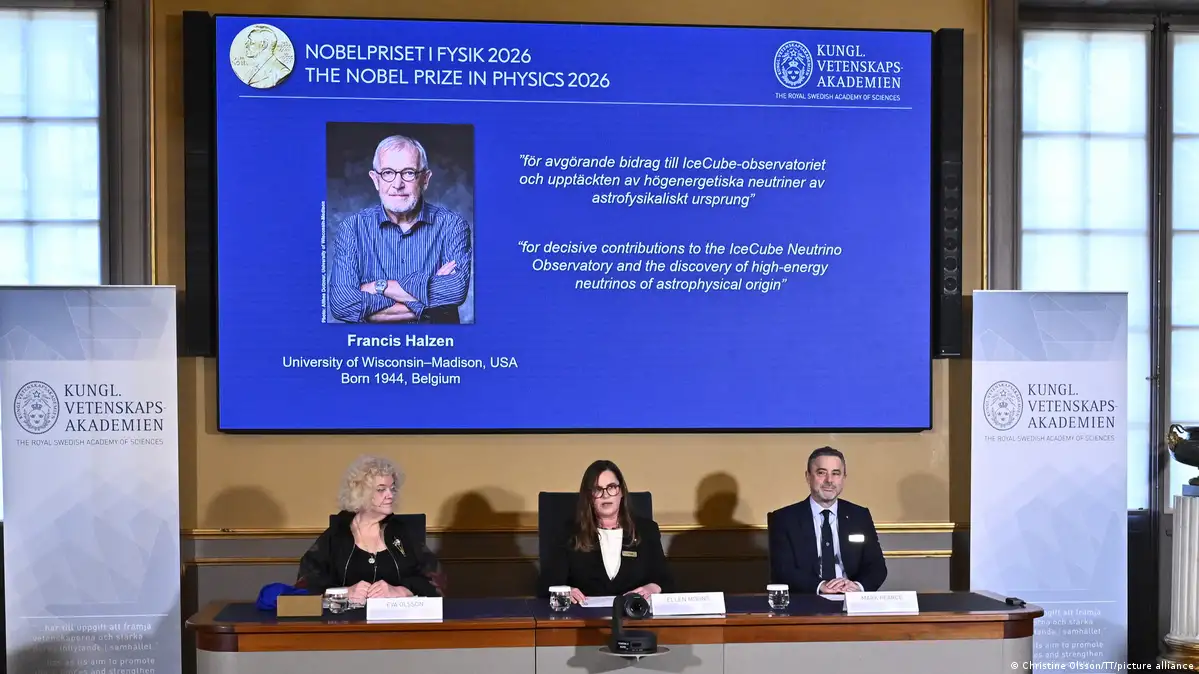
瑞典皇家科学院在斯德哥尔摩公布了2026年诺贝尔物理学奖评选结果,决定将该年度奖项单独授予82岁的物理学家弗朗西斯·哈尔岑。官方颁奖词明确肯定了他对南极冰立方中微子观测站建设作出的决定性贡献,以及在探测源自宇宙深处的天体物理高能中微子方面的科学建树。作为该奖项的唯一得主,哈尔岑将全额获得1200万瑞典克朗(约合120万美元)的奖金。
The Royal Swedish Academy of Sciences announced in Stockholm on October 6 that the 2026 Nobel Prize in Physics has been conferred upon 82-year-old physicist Francis Halzen. In its official citation, the academy recognized Halzen for his decisive contributions to the IceCube Neutrino Observatory and the landmark discovery of high-energy neutrinos of astrophysical origin. As the sole laureate for this year's physics award, Halzen will receive the full prize sum of 12 million Swedish kronor, equivalent to approximately $1.2 million.
出生于比利时的哈尔岑现已加入美国国籍,长期在威斯康星大学麦迪逊分校担任物理学教授,该校也是冰立方国际合作项目的核心牵头单位。诺贝尔物理学委员会指出,哈尔岑带领国际科研与工程团队打造出功能独特的观测设备,其展现的科学远见与坚持不懈的领导力,为当代物理学界探索极端宇宙环境奠定了关键基础。
Halzen, who was born in Belgium and is now a US citizen, is a professor of physics at the University of Wisconsin–Madison, which serves as the lead operating institution for the Antarctic IceCube project. The Nobel Committee for Physics stated that Halzen guided an international collaboration of researchers and engineers to deliver an unprecedented scientific instrument, adding that his persistent vision and leadership established a foundation for probing extreme cosmic phenomena.
02冰立方探测原理与极端环境工程IceCube Detection Mechanism and Antarctic Engineering
中微子是质量极小且不带电荷的亚原子粒子,在宇宙中无处不在,太阳等恒星每秒产生数以万亿计的中微子穿透人体与地球,却几乎不与常规物质发生相互作用。由于科学家无法直接追踪这些穿行于空间的粒子,探测工作依赖于测量中微子偶尔与原子核发生碰撞时产生的次级带电粒子或微弱切伦科夫闪光信号。冰立方项目专注于寻找由太阳系外遥远星系剧烈宇宙事件产生的高能中微子,这类粒子携带着常规天文仪器难以获取的极端环境信息。
Neutrinos are subatomic particles with extremely tiny mass that pervade the universe in vast numbers. Stars like the Sun generate trillions of low-energy neutrinos that pass harmlessly through human bodies and planetary matter every second without leaving a trace. Because researchers cannot observe these ghost-like particles directly in flight, detection requires measuring the rare collisions that occur when a neutrino strikes an atomic nucleus, producing secondary charged particles and faint flashes of light. IceCube specifically targets high-energy neutrinos generated by violent astrophysical processes in distant galaxies, which act as cosmic messengers carrying data about extreme environments that standard telescopes cannot observe.
哈尔岑于1988年提出利用南极深处纯净透明的冰层作为天然探测介质。工程团队随后克服严酷的极地作业环境,通过热水钻孔将数千个篮球大小的光学传感器固定在长电缆上,垂直下放并冻结在南极1立方公里的深层冰体中。这一选址不仅为传感器提供了高度清澈的介质来记录微弱光信号,还使探测器远离了人为干扰和地震震动带来的环境影响,成功将巨大的极地冰体转化为灵敏的粒子物理观测阵列。
Halzen conceived the idea of transforming deep Antarctic ice into a massive particle detector in 1988, recognizing that clear glacial ice could effectively preserve the light generated by rare neutrino interactions. To construct the facility, researchers and engineers drilled deep holes into the ice sheet and lowered thousands of basketball-sized optical sensors attached to long cables across a cubic kilometer of ice, allowing them to freeze firmly in place. Beyond providing pristine optical clarity, the remote South Pole location shielded the sensitive instrument array from human interference and seismic vibrations, turning an extreme glacial volume into an operational particle observatory.
03重大科学发现与天文学新突破Scientific Breakthroughs and a New Era of Astronomy
冰立方中微子观测站在正式投入运行后不久,便在2013年首次成功探测到来自太阳系外的高能天体物理中微子。研究团队随后利用这些极罕见的碰撞信号追踪溯源,成功锁定了首个距离地球37亿光年的宇宙中微子源。科研人员指出,这些被捕获的高能中微子就像来自宇宙深处的指纹,携带了其发源天体与剧烈物理过程的关键线索,为解答基础物理学领域的核心疑问提供了直接证据。
Shortly after becoming operational, the IceCube Neutrino Observatory achieved a landmark milestone in 2013 by recording the first detection of high-energy extraterrestrial neutrinos originating outside the Solar System. Scientists collaborating on the project subsequently traced these rare collision signals back to their origin, successfully identifying a cosmic neutrino source situated 3.7 billion light-years away from Earth. Researchers noted that the detected neutrinos act like cosmic fingerprints, carrying direct evidence about the distant objects and extreme environments that produced them, while helping physicists address fundamental questions about the universe.
这项突破为天文学研究开创了全新的观测分支。由于中微子几乎不与沿途星际物质发生相互作用,能够沿直线穿行数十亿光年而不被吸收或偏折,天文学家得以突破传统光学和电磁望远镜的视界限制,直接观测遥远星系中最极端、最剧烈的天体物理现象,揭示宇宙演化历程中的关键物理机制。
The operational success of IceCube has established an entirely new observational pathway for astronomy. Because high-energy neutrinos travel vast distances across space without being absorbed or deflected by intervening matter or magnetic fields, they allow scientists to probe violent cosmic events in distant galaxies that remain difficult or impossible to capture using conventional electromagnetic telescopes, thereby offering unprecedented insight into cosmic evolution.
冰立方探测与哈尔岑诺奖之路Timeline of IceCube and Halzen's Nobel Prize
梳理弗朗西斯·哈尔岑提出南极中微子探测构想、冰立方探测器取得重大突破至荣获诺贝尔物理学奖的关键历程。
Traces the path from Francis Halzen's South Pole neutrino proposal to IceCube's breakthrough detection and his 2026 Nobel Prize.
弗朗西斯·哈尔岑首次提出在南极利用深层冰川构建巨型探测器捕捉中微子的构想,计划利用清澈冰层记录罕见粒子碰撞产生的微弱闪光。
Francis Halzen first presented his vision to convert deep Antarctic glacial ice into a massive particle detector to capture faint flashes from neutrino collisions.
南极冰立方中微子天文台投入运行后不久,于2013年首次成功记录到来自太阳系外的高能中微子,开创了天文学观测的全新窗口。
Shortly after becoming operational, the IceCube Neutrino Observatory achieved the first detection of high-energy extraterrestrial neutrinos originating outside the solar system.
瑞典皇家科学院宣布将2026年诺贝尔物理学奖授予82岁的哈尔岑,表彰其对冰立方中微子天文台的决定性贡献及发现天体物理高能中微子,独享1200万瑞典克朗奖金。
The Royal Swedish Academy of Sciences awarded the 2026 Nobel Prize in Physics and 12 million Swedish kronor to 82-year-old Francis Halzen for his decisive contributions to IceCube.
04各方反应与科学界评价Reactions and Commentary from Halzen and Officials
在得知获奖消息后,哈尔岑在意大利通过电话向诺贝尔委员会与新闻发布会表达了感受。他表示自己感到非常意外,尽管此前曾有人预测他可能获奖,但正式消息依然让他感觉很不真实。哈尔岑坦言这项长期探索充满风险且成功毫无保证,当初项目启动时极少有人相信构想能真正实现,连他自己也未曾料到探测器能运行得如此顺利,这一系列重大发现离不开极大的幸运。
Speaking by phone from Italy following the announcement, Halzen expressed surprise at receiving the prize, noting that while others had predicted the honor, the formal award still felt strange. Halzen described the decade-spanning effort as an adventure where success was never guaranteed, emphasizing that very few people believed the initial concept would actually work when the project started, including himself, and acknowledging that sheer luck played a substantial role in making the observatory function so effectively.
哈尔岑特别向早期参与该探索的科研伙伴致谢,指出在项目起步阶段,没有墨守成规或保守的物理学家愿意加入这一冒险计划,正是那些勇敢且富有才华的科研人员选择与他同行,才促成了今日的成果。比利时首相巴特·德韦弗向哈尔岑致以诚挚祝贺,指出他是第11位荣获诺贝尔奖的比利时人,也是该国历史上第2位诺贝尔物理学奖得主;诺贝尔物理学委员会主席马克·皮尔斯亦公开赞扬哈尔岑的坚持与科学远见,称其团队打造的杰出观测设备为天文学开辟了全新纪元。
Halzen dedicated the recognition to the early team members who took a risk on the undertaking, pointing out that while no respectable, conservative physicists would have joined the project in its infancy, many talented and courageous researchers did. Official tributes also poured in internationally. Belgian Prime Minister Bart De Wever extended heartfelt congratulations, celebrating Halzen as the 11th Belgian Nobel laureate and the country's second physics recipient. Meanwhile, Nobel Committee for Physics Chair Mark Pearce praised Halzen's tenacity and scientific vision, stating that the fantastic instrument built by his team paved the way for an entirely new kind of astronomy.